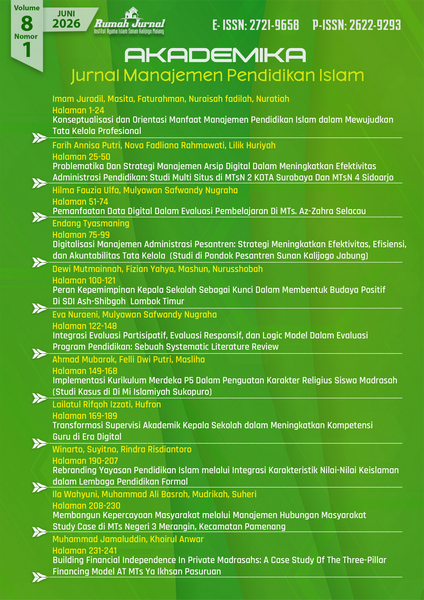
Building Financial Independence In Private Madrasahs: A Case Study Of The Three-Pillar Financing Model AT MTs Ya Ikhsan Pasuruan
DOI:
https://doi.org/10.51339/akademika.v8i1.5446Keywords:
Financial Independence, Private Madrasah, Education Financing, Sharia PrinciplesAbstract
This study aims to examine the financial management practices of Islamic education in private madrasahs and to formulate a contextual and sustainable financing model. The research focuses on MTs Ya Ikhsan Andonosari, a private Islamic junior high school in Pasuruan Regency, which has managed to maintain financial resilience through diversified funding strategies based on Islamic values. This qualitative research employs a case study design. Data were collected through in-depth interviews, participatory observation, and document analysis, and analyzed using Miles and Huberman's interactive model. The findings reveal that MTs Ya Ikhsan implements financial management through a structured process involving planning, implementation, and reporting, while upholding the principles of trustworthiness, justice, efficiency, and transparency. Nevertheless, the school faces challenges such as dependency on government funding (BOS), limited involvement from the foundation, and inadequate managerial capacity in financial governance. Based on these findings, the study proposes a Three-Pillar Financial Independence Model for madrasahs, consisting of: (1) state-funded support, (2) community-based social funds, and (3) self-generated entrepreneurial income. This model integrates public funds, community participation, and local economic initiatives. This study contributes conceptually to the development of a participatory and sharia-based Islamic education financing system. It also provides practical insights for policymakers to design more adaptive financial policies that align with the realities of private madrasahs in Indonesia.
Downloads
References
Abrori, M Sayyidul, and Moh. Solikul Hadi. “Integral Values in Madrasah: To Foster Community Trust in Education.” Istawa : Jurnal Pendidikan Islam 5, no. 2 (2020): 160. https://doi.org/10.24269/ijpi.v5i2.2736.
Assyakurrohim, Dimas, Dewa Ikhram, Rusdy A Sirodj, and Muhammad Win Afgani. “Metode Studi Kasus Dalam Penelitian Kualitatif.” Jurnal Pendidikan Sains Dan Komputer 3, no. 01 (2022): 1–9. https://doi.org/10.47709/jpsk.v3i01.1951.
Biancone, P. P., & Radwan, M. “Social Finance and Financing Social Enterprises.” EJIF : European Journal of Islamic Finance 0, no. 0 (2019): 50–61.
Buchari, Agustini, and Erni Moh. Saleh. “Merancang Pengembangan Madrasah Unggul.” Journal of Islamic Education Policy 1, no. 2 (2017): 95–112. https://doi.org/10.30984/j.v1i2.429.
Effendi, Mamat Rachmat. “Development of Cash Waqf Benefits Synergy Foundation in the Economic Empowerment of the Ummat.” Amwaluna: Jurnal Ekonomi Dan Keuangan Syariah 5, no. 1 (2020): 29–39. https://doi.org/10.29313/amwaluna.v5i1.6916.
Erianti, Murniati, AR, Niswanto. “Efektivitas Pembiayaan Bantuan Operasional Sekolah Pada Madrasah Tsanawiyah Swasta Sirajul Huda Di Kabupaten Pidie Jaya.” Jurnal Administrasi Pendidikan : Program Pascasarjana Unsyiah 5, no. 4 (2017): 248–52.
Forgues, Bernard, Royston Greenwood, Ignasi Martí, Philippe Monin, and Peter Walgenbach. “New Institutionalism: Roots and Buds.” Management (France) 15, no. 5 (2012): 459–67. https://doi.org/10.3917/mana.155.0460.
Ismail, Feiby, and Nindy Sumaila. “Implementasi Manajemen Pembiayaan Dalam Pengelolaan Dana Bantuan Operasional Sekolah (BOS) Di Madrasah Aliyah Negeri 1 Bitung, Sulawesi Utara.” MANAGERIA: Jurnal Manajemen Pendidikan Islam 5, no. 1 (2020): 1–18. https://doi.org/10.14421/manageria.2020.51-01.
Jinan, Muhammad Riyadlul, Muhammad Syapiuddin, and Ulyan Nasri. “Holistic Integration: Syariah Finance Principles in Islamic Education Management.” Jurnal Ilmiah Profesi Pendidikan 9, no. 2 (2024): 1343–50. https://doi.org/10.29303/jipp.v9i2.2243.
Johan, Suwinto. “What Can Financial Technology Learn from Syariah Finance on Ecosystem: Collaboration.” International Journal of Application on Economics and Business 1, no. 1 (2023): 588–94. https://doi.org/10.24912/v1i1.588-594.
Lestari, Lidya, and Waizul Qarni. “Efektivitas Pengelolaan Dana Bantuan Operasional Sekolah (BOS) Madrasah Di Kantor Wilayah Kementerian Agama Provinsi Sumatera Utara.” VISA: Journal of Vision and Ideas 3, no. 1 (2022): 122–28. https://doi.org/10.47467/visa.v3i2.1268.
Qomaruddin, Qomaruddin, and Halimah Sa’diyah. “Kajian Teoritis Tentang Teknik Analisis Data Dalam Penelitian Kualitatif: Perspektif Spradley, Miles Dan Huberman.” Journal of Management, Accounting, and Administration 1, no. 2 (2024): 77–84. https://doi.org/10.52620/jomaa.v1i2.93.
Ruba’i, Muhammad, S. Ali Jadid Al Idrus, and Muhammad Thohri. “Management of School Operational Assistance Funds (BOS) to Enhance Extracurricular Activities at Yusuf Abdussatar Ibtidaiyah Madrasah, Kediri West Lombok.” Jurnal Ilmiah Profesi Pendidikan 9, no. 2 (2024): 1389–95. https://doi.org/10.29303/jipp.v9i2.2236.
Sukino. “Social Capital in Developing Madrasah : Social Involvement Strategy to Develop Madrasah in the Muslim Minority Area of District Mandor , Ladak West Kalimantan Indonesia.” Journal of Education and Practice 9, no. 10 (2018): 45–58.
Syafri, Ulil Amri, Endin Mujahidin, Abas Mansur Tamam, Rifkah Dewi, Aris Kusnadi, Khoirul Umam, and Salma Evie. “Konsep Manajemen Keuangan Untuk Pendidikan Islam Berbasis Prinsip ZISWAF.” Tawazun: Jurnal Pendidikan Islam 15, no. 3 (2022): 357. https://doi.org/10.32832/tawazun.v15i3.8393.
Wijaya, Fadila Ramadona, Fehan Alya Rahmi Lubis, Mhd. Najib Sihab Siregar, and Azmi Ayu Fauziah Batubara. “Sumber Data, Subjek Penelitian, Dan Isu Terkait.” Jurnal Edukatif 3, no. 2 (2025): 271–76.
Downloads
Published
How to Cite
Issue
Section
License
Copyright (c) 2026 Khoirul Anwar, Muhammad Jamaluddin

This work is licensed under a Creative Commons Attribution-ShareAlike 4.0 International License.





.png)