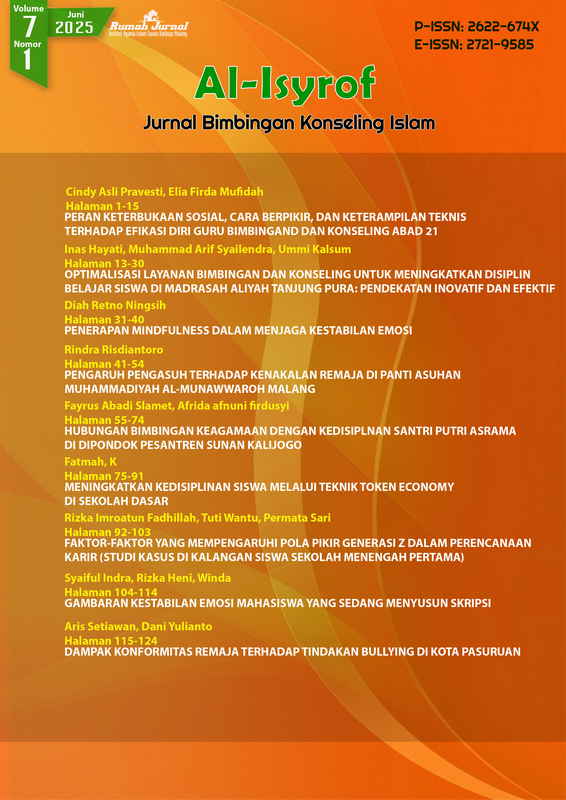
Peran Keterbukaan Sosial, Cara Berpikir, dan Keterampilan Teknis terhadap Efikasi Diri Guru Bimbingand dan Konseling Abad 21
DOI:
https://doi.org/10.51339/isyrof.v7i1.3676Keywords:
Efikasi Diri, Keterbukaan Sosial, Cara Berpikir, Keterampilan Teknis, Guru Bk Abad 21Abstract
Penelitian ini bertujuan untuk menganalisis hubungan antara keterbukaan pada situasi sosial, cara berpikir, dan keterampilan teknis terhadap efikasi diri guru Bimbingan dan Konseling (BK) di Kabupaten Gresik. Menggunakan pendekatan kuantitatif dengan desain deskriptif korelasional, penelitian ini melibatkan 119 guru BK dari wilayah Utara, Tengah, dan Selatan. Data dikumpulkan melalui angket tertutup berbasis skala Likert dan dianalisis menggunakan statistik deskriptif, uji normalitas, ANOVA, dan korelasi Spearman. Hasil penelitian menunjukkan bahwa keterbukaan sosial memiliki hubungan positif yang signifikan dengan cara berpikir dan keterampilan teknis. Di antara ketiga indikator, cara berpikir memiliki skor tertinggi, sementara keterampilan teknis menjadi indikator dengan skor terendah. Selain itu, terdapat perbedaan efikasi diri yang signifikan antar wilayah administratif, di mana guru BK di wilayah Utara memiliki efikasi diri tertinggi. Temuan ini menekankan pentingnya penguatan keterbukaan sosial, kemampuan berpikir kritis, dan keterampilan teknis sebagai strategi peningkatan efikasi diri guru BK dalam menghadapi tantangan pendidikan abad ke-21
Downloads
References
Bandura, A. (1995). Self-efficacy in Changing Societies. Cambridge University Press.
Bandura, A. (1999). Social cognitive theory of personality. In Handbook of personality: Theory and research, 2nd ed. (pp. 154–196). Guilford Press.
Bandura, A. (2001). Social Cognitive Theory: An Agentic Perspective. Annual Review of Psychology, 52(1), 1–26. https://doi.org/10.1146/annurev.psych.52.1.1
Bardhoshi, G., & Um, B. (2021). The Effects of Job Demands and Resources on School Counselor Burnout: Self‐Efficacy as a Mediator. Journal of Counseling & Development, 99(3), 289–301. https://doi.org/10.1002/jcad.12375
Bodenhorn, N., & Skaggs, G. (2005). Development of the School Counselor Self-Efficacy Scale. Measurement and Evaluation in Counseling and Development, 38(1), 14–28. https://doi.org/10.1080/07481756.2005.11909766
Buch, R., Säfvenbom, R., & Boe, O. (2015). The relationships between academic self-efficacy, intrinsic motivation, and perceived competence. Journal of Military Studies, 6(1), 19–35. https://doi.org/10.1515/jms-2016-0195
Downs, J. R. (1988). What Critical Thinking Can Do For You As A Counselor. TACD Journal, 16(1), 41–48. https://doi.org/10.1080/1046171X.1988.12034324
Gallagher, M. W. (2012). Self-Efficacy. In Encyclopedia of Human Behavior (pp. 314–320). Elsevier. https://doi.org/10.1016/B978-0-12-375000-6.00312-8
Gong, J., Li, Y., Niu, B., Liu, X., Wang, Y., Zhou, B., & Hai, M. (2023). The relationship between openness and social anxiety: the chain mediating roles of social networking site use and self-evaluation. BMC Psychology, 11(1), 391. https://doi.org/10.1186/s40359-023-01412-y
Kartika, A. D., Hidajad, A., Rengganis, R., Wiyono, B. D., & Pravesti, C. A. (2021). Upgrading Counselor’s Critical Thinking Skills for High School Counselors in Surabaya to Improve Student Problem Solving Readiness during The Pandemic.
Lindqvist, H., Forsberg, L., Enebrink, P., Andersson, G., & Rosendahl, I. (2017). The relationship between counselors’ technical skills, clients’ in-session verbal responses, and outcome in smoking cessation treatment. Journal of Substance Abuse Treatment, 77, 141–149. https://doi.org/10.1016/j.jsat.2017.02.004
Mangundjaya, W. L., Arumi, M. S., & Wicaksana, S. A. (2024). How Diversities in Demographic Have Related to Psychological Empowerment? Revista de Gestão Social e Ambiental, 18(7), e05344. https://doi.org/10.24857/rgsa.v18n7-074
Mufidah, E. F., & Lathifah, M. (2020). Penggunaan Teori Konseling dalam Layanan Konseling Individu di SMP Kabupaten Gresik. Jurnal Bimbingan Dan Konseling Terapan, 4(2), 17–23. https://ojs.unpatti.ac.id/index.php/bkt/article/view/1143
Nash, V. R., Ponto, J., Townsend, C., Nelson, P., & Bretz, M. N. (2013). Cognitive Behavioral Therapy, Self-Efficacy, and Depression in Persons with Chronic Pain. Pain Management Nursing, 14(4), e236–e243. https://doi.org/10.1016/j.pmn.2012.02.006
Pravesti, C. A., Mufidah, E. F., Nurlitasani, E. N., & ... (2023). Pengembangan Skala Efikasi Diri Guru Bimbingan Dan Konseling Abad-21. … of Research: Jurnal …, 10(4), 407–415. https://ojs.unpkediri.ac.id/index.php/efektor/article/view/21309%0Ahttps://ojs.unpkediri.ac.id/index.php/efektor/article/download/21309/3628
Salsabila Nadiani, H. F., & Agus Setiawati, F. (2022). Openness Personality as a Mediator of the Influence Social Support Toward Subjective Well-Being. Eduvest - Journal of Universal Studies, 2(12), 2757–2775. https://doi.org/10.59188/eduvest.v2i12.697
Seziş, Ç. (2023). An Academic Review About Human Psychology Demographics Features. Collaborate, Current Science, 5(5–9). https://doi.org/10.5281/zenodo.8373461
Shengyao, Y., Salarzadeh Jenatabadi, H., Mengshi, Y., Minqin, C., Xuefen, L., & Mustafa, Z. (2024). Academic resilience, self-efficacy, and motivation: the role of parenting style. Scientific Reports, 14(1), 5571. https://doi.org/10.1038/s41598-024-55530-7
Wahyuni, F., & Kurniawan, C. (2022). Asesmen Self-Efficacy Konselor dalam Konseling : Pengembangan dan Validasi. Bulletin of Counseling and Psychotherapy, 4(2), 235–241. https://doi.org/10.51214/bocp.v4i2.196
Yaumas, N. E., Syafril, S., Noor, N. Mohd., Mahmud, Z., Umar, J., Wekke, I. S., & Rahayu, T. (2018). The Importance of Counselling Basic Skills for the Counsellors. International Journal of Pure and Applied Mathematics, 119(18). http://www.acadpubl.eu/hub/
Downloads
Published
How to Cite
Issue
Section
License
Copyright (c) 2025 Cindy Asli p, Elia Firda Mufidah

This work is licensed under a Creative Commons Attribution-ShareAlike 4.0 International License.


 ISSN
ISSN